

Join our Telegram channel to get new information
A recent study by the US Financial Industry Regulatory Authority (FINRA) Investor Education Foundation revealed the reasons why new investors will start buying cryptocurrencies in 2022.
Recommendations from friends and the main reasons for FOMO for first-time Crypto investors
According to the survey, 31% of new cryptocurrency investors cited “friend recommendations” as the main reason for entering the cryptocurrency space. By comparison, only 8% of stock or bond investors cite this as a first-time motivation, stating that there is a "social element" to investing in cryptocurrency that is not seen in investing in stocks or bonds.
After recommendations from friends, the ability to start with little money is the second most important reason for entering the digital currency market, the same reason 24% of stock and bond investors started investing.
Interestingly, 10% of the people surveyed said they bought cryptocurrency for the first time out of fear of missing out on an opportunity to make money. This is known as FOMO in the crypto community.
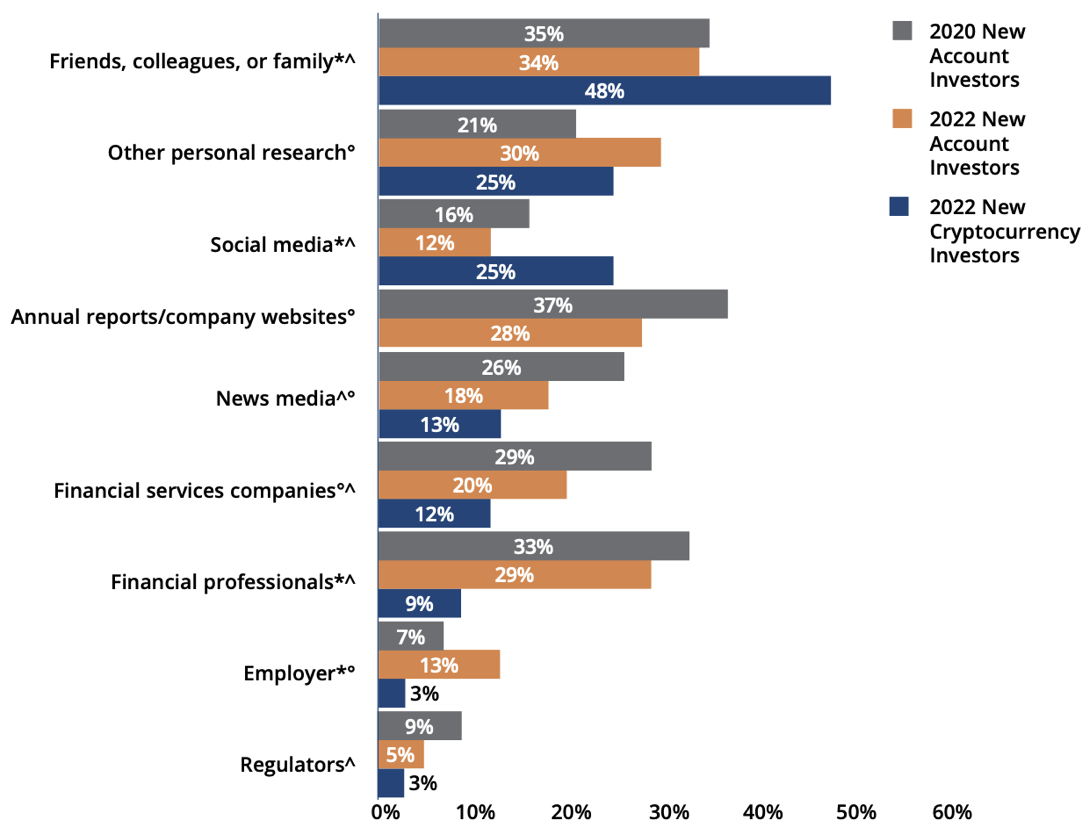
According to the survey, nearly half of cryptocurrency investors say they get information about cryptocurrencies from friends, family or colleagues.
Social media is the second most popular source of information, with 25% of respondents saying they learned about the cryptocurrency market through this platform. This shows that many cryptocurrency beginners rely on these sources for better understanding.
The survey found that young adults, with an average age of 37, were less likely to invest in cryptocurrency and less likely to have a four-year college degree, as 28.5% did. On the other hand, equity investors are older, with an average age of 43, and 46.3% have a bachelor's degree.
Interestingly, the research suggests that digital asset owners don't know as much about cryptocurrencies as they first thought. Investors in digital assets scored only 26.6% on the five-item survey, which asked questions about cryptocurrency withdrawals, conversion to US dollars, taxes paid and transaction fraud.
Overall, the research shows that the social element and the influence of friends and family is a strong driver for new investors to enter the cryptocurrency market as many rely on this source of information. It also shows that many new investors may not fully understand the complexities and risks involved in cryptocurrencies.
Cryptocurrency adoption is on the rise in Europe amid market struggles.
Cryptocurrency use is growing in Europe, but there is a significant gender gap in ownership.
In the United Kingdom, few respondents to a March 2022 survey said they owned any cryptocurrency, with bitcoin being the preferred cryptocurrency. Also, the percentage of people who own cryptocurrencies in Germany is a few points higher than those who intend to invest in them in the future.
However, among those who have already invested in cryptocurrency, nearly half plan to increase their investment in the next six months. Bitcoin remains the most popular currency among those who have invested or want to invest in France, including NFTs.
With more than 50% of those looking to buy and hold cryptocurrencies in Switzerland, Bitcoin is a priority. Europe, on the other hand, has seen a modest increase in adoption of stricter cryptocurrency regulations despite increased adoption.
In the year In the first half of 2022, more than 50% of those surveyed who held cryptocurrency expressed their intention to increase their holdings in the next year. This feeling is more pronounced among the younger generation than the older generation. Bitcoin and Ethereum were the cryptocurrencies of choice during this period.
However, the cryptocurrency market has seen a decline in value since the spring of 2022, which has led to a loss of investor enthusiasm and negative asset price movements in Europe.
The collapse of FTX and the failure of blockchain prompted European lawmakers to agree to a set of licensing and regulatory rules by 2024 to ensure consumer protection, market integrity and financial stability.
In Europe, where countries like Cyprus have been hit harder than others due to a lack of national regulation, the cryptocurrency's fall has had mixed results. However, Germany, the Netherlands and France have suffered to some extent from the damage caused by national laws that protect them from serious injury.
Will Central Bank Digital Currencies Encourage Cryptocurrency Adoption?
We are now in an economic recession because central banks—especially the Federal Reserve—make decisions that do more harm than good.
The Fed spent a lot of money during the pandemic, but now it seems focused on fighting inflation by raising interest rates and possibly using quantitative easing (QT).
This decision has created an opportunity for those who have cash to buy properties from the less fortunate and those who need to sell. The result is an unbalanced economy where those who don't need get more and those who need to spend get less. This can be remedied if the central bank targets nominal GDP rather than inflation and institutes moderate QE and cuts interest rates.
On the other hand, the consequences of continuing the previous course may lead to termination. For example, more than $3 trillion in U.S. home loans are expected to be refinanced over the next two years, reducing commercial real estate prices by 40 percent.
Investors are piling into cryptocurrencies as a hedge against what they see as a problem in the financial world. It remains to be seen whether this trend will continue. However, central banks around the world may implement central bank digital currencies (CBDCs) to send bitcoin-like tokens directly into people's wallets. This step simplifies the process and ensures that the poor can withdraw money, while the rich cannot save or reap the benefits.
This could make cryptocurrencies accessible to a wider demographic. Additionally, institutional currency helps build trust in CBCCs, thereby encouraging further adoption. For now, investors can wait for more surveys to get updates on the factors affecting cryptocurrency adoption.
Related articles
Ecoterra - a new environmental cryptocurrency
- Certified certificate
- Professional doxxed team
- Win free crypto to reuse
- Environmental gamification work
- Pre-order now - more than $2 million has been raised
- Yahoo Finance, Cointelegraph's flagship project
Join our Telegram channel to get new information